Start with the fleet you have
Your aircraft, payloads, communications and ground systems shape the integration. We start with your mission requirements and agree the interfaces, constraints and acceptance process.
Discuss integration with your fleet
The execution foundation for human-supervised aircraft missions: verify signed requests, supervise operations and preserve the mission record.
Discuss Pterops OSCheck signed requests against approved permissions and operating constraints.
Connect accepted operations to the autopilot and monitor their progress.
Preserve command activity and telemetry for a traceable mission record.
Product overview
Updated
Pterops is being developed around documented interfaces and modular components, enabling assessed integrations with customer aircraft, payloads and operational systems.
Your aircraft, payloads, communications and ground systems shape the integration. We start with your mission requirements and agree the interfaces, constraints and acceptance process.
Discuss integration with your fleetPterops OS handles mission-request verification, supervised execution and recorded outcomes. Your autopilot retains stabilisation, state estimation and low-level flight control.
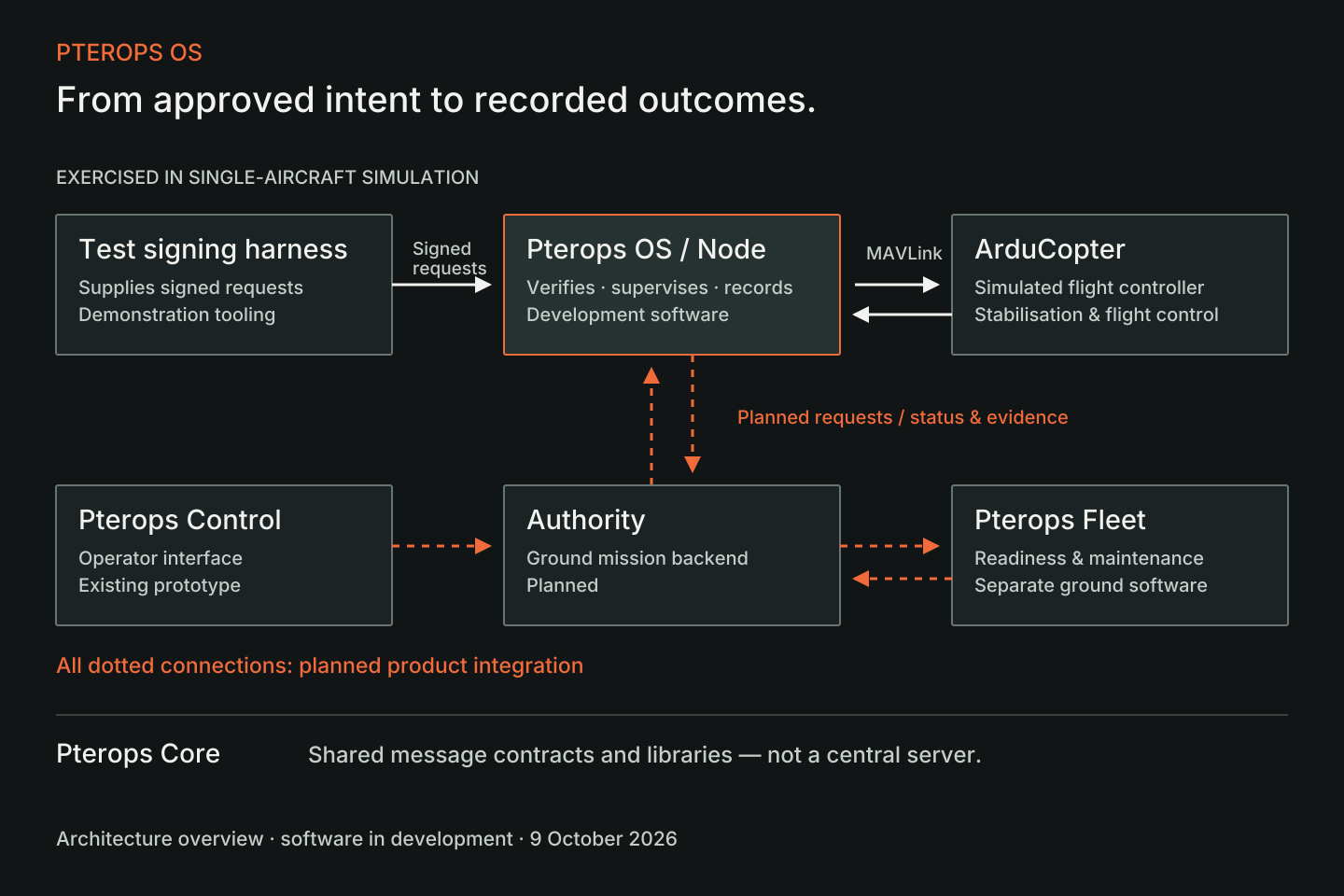
Pterops OS spans onboard software and ground services. Node is intended for a Linux companion computer.
Pterops Core supplies shared message definitions and signing/verification libraries. It is a code foundation, not a central server through which commands pass.
Authority is the planned backend for preparing, signing and dispatching approved requests. Control provides the operator interface. Fleet supplies readiness records and does not command aircraft.
Open architecture does not mean universal aircraft compatibility or an entirely open-source platform. The licensing plan includes Apache-2.0 contracts, SDK bindings and simulator tooling; Node, Authority, Control and product applications are proprietary. Public source releases and technical documentation are not yet available. Contractual source access for audit is a separate arrangement.
Current stage: Pterops OS is development software, demonstrated with a single ArduCopter in software-in-the-loop simulation. Physical-flight validation and production integration with Pterops Control and Fleet remain pending.
Read the technical evidence